



given a number n and we have to print the arrow star pattern of maximum n number of stars.
The star pattern of input 4 will look like −
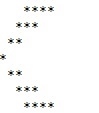
Example
Input: 3
Output:

Input: 5
Output:
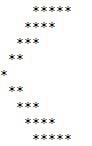

下面使用的方法如下:
- 以整数形式输入。
- 然后打印n个空格和n个星号。
- 递减直到n>1。
- 现在递增直到n。
- 并按照递增顺序打印空格和星号。
算法
Start
In function int arrow(int num)
   Step 1-> declare and initialize i, j
   Step 2-> Loop For i = 1 and i <= num and i++
      Loop For j = i and j < num and j++
         Print a space
      Loop For j = i and j <= num and j++
         Print "*"
         Print newline
   Step 3-> Loop For i = 2 and i <= num and i++
      Loop For j= 1 and j < I and j++
         Print a space
      Loop For j = 1 and j <= i and j++
         Print "*"
         Print newline
In function int main()
   Step 1-> declare and initialize num = 4
   Step 2-> call arrow(num)
Example
演示
#include <stdio.h>
// arrow function
int arrow(int num) {
   int i, j;
   // Prints the upper part of the arrow
   for (i = 1; i <= num; i++) {
      // to print the spaces
      for (j = i; j < num; j++) {
         printf(" ");
      }
      // to print the * for the pattern
      for (j = i; j <= num; j++) {
         printf("*");
      }
      printf("</p><p>");
   }
   // Prints lower part of the arrow
   for (i = 2; i <= num; i++) {
      // to print the spaces
      for (j = 1; j < i; j++) {
         printf(" ");
      }
      // to print the * for the pattern
      for (j = 1; j <= i; j++) {
         printf("*");
      }
      printf("</p><p>");
   }
   return 0;
}
int main() {
   // get the value from user
   int num = 4;
   // function calling
   arrow(num);
   return 0;
}
输出
如果运行上述代码,将生成以下输出 −




