



本篇文章给大家带来的内容是关于spring security原理的介绍(附代码),有一定的参考价值,有需要的朋友可以参考一下,希望对你有所帮助。
知彼知己方能百战百胜,用 Spring Security 来满足我们的需求最好了解其原理,这样才能随意拓展,本篇文章主要记录 Spring Security 的基本运行流程。
过滤器
Spring Security 基本都是通过过滤器来完成配置的身份认证、权限认证以及登出。
Spring Security 在 Servlet 的过滤链(filter chain)中注册了一个过滤器 FilterChainProxy,它会把请求代理到 Spring Security 自己维护的多个过滤链,每个过滤链会匹配一些 URL,如果匹配则执行对应的过滤器。过滤链是有顺序的,一个请求只会执行第一条匹配的过滤链。Spring Security 的配置本质上就是新增、删除、修改过滤器。
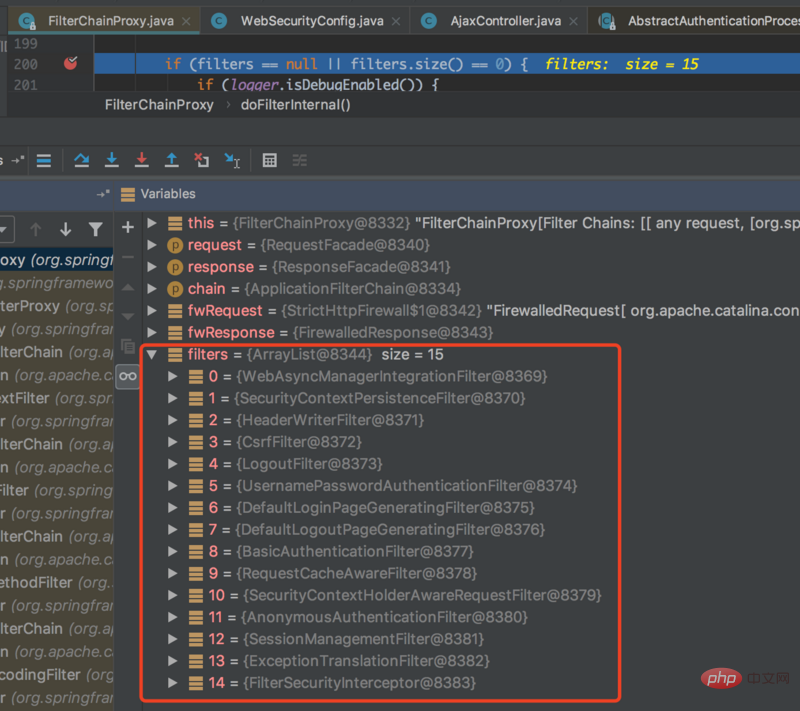
默认情况下系统帮我们注入的这 15 个过滤器,分别对应配置不同的需求。接下来我们重点是分析下 UsernamePasswordAuthenticationFilter 这个过滤器,他是用来使用用户名和密码登录认证的过滤器,但是很多情况下我们的登录不止是简单的用户名和密码,又可能是用到第三方授权登录,这个时候我们就需要使用自定义过滤器,当然这里不做详细说明,只是说下自定义过滤器怎么注入。
@Override
protected void configure(HttpSecurity http) throws Exception {

    http.addFilterAfter(...);
    ...
 }
身份认证流程
在开始身份认证流程之前我们需要了解下几个基本概念
SecurityContextHolder
SecurityContextHolder 存储 SecurityContext 对象。SecurityContextHolder 是一个存储代理,有三种存储模式分别是:
- MODE_THREADLOCAL:SecurityContext 存储在线程中。
- MODE_INHERITABLETHREADLOCAL:SecurityContext 存储在线程中,但子线程可以获取到父线程中的 SecurityContext。
- MODE_GLOBAL:SecurityContext 在所有线程中都相同。
SecurityContextHolder 默认使用 MODE_THREADLOCAL 模式,SecurityContext 存储在当前线程中。调用 SecurityContextHolder 时不需要显示的参数传递,在当前线程中可以直接获取到 SecurityContextHolder 对象。
SecurityContext context = SecurityContextHolder.getContext();
Authentication authentication = context.getAuthentication();
2.Authentication
Authentication 即验证,表明当前用户是谁。什么是验证,比如一组用户名和密码就是验证,当然错误的用户名和密码也是验证,只不过 Spring Security 会校验失败。
Authentication 接口
public interface Authentication extends Principal, Serializable {
       //获取用户权限,一般情况下获取到的是用户的角色信息
       Collection<? extends GrantedAuthority> getAuthorities();
       //获取证明用户认证的信息,通常情况下获取到的是密码等信息,不过登录成功就会被移除
       Object getCredentials();
       //获取用户的额外信息,比如 IP 地址、经纬度等
       Object getDetails();
       //获取用户身份信息,在未认证的情况下获取到的是用户名,在已认证的情况下获取到的是 UserDetails (暂时理解为,当前应用用户对象的扩展)
       Object getPrincipal();
       //获取当前 Authentication 是否已认证
       boolean isAuthenticated();
       //设置当前 Authentication 是否已认证
       void setAuthenticated(boolean isAuthenticated);
}
3.AuthenticationManager ProviderManager AuthenticationProvider
其实这三者很好区分,AuthenticationManager 主要就是为了完成身份认证流程,ProviderManager 是 AuthenticationManager 接口的具体实现类,ProviderManager 里面有个记录 AuthenticationProvider 对象的集合属性 providers,AuthenticationProvider 接口类里有两个方法
public interface AuthenticationProvider {
    //实现具体的身份认证逻辑,认证失败抛出对应的异常
    Authentication authenticate(Authentication authentication)
            throws AuthenticationException;
    //该认证类是否支持该 Authentication 的认证
    boolean supports(Class<?> authentication);
}
接下来就是遍历 ProviderManager 里面的 providers 集合,找到和合适的 AuthenticationProvider 完成身份认证。

特色介绍: 1、ASP+XML+XSLT开发,代码、界面、样式全分离,可快速开发 2、支持语言包,支持多模板,ASP文件中无任何HTML or 中文 3、无限级分类,无限级菜单,自由排序 4、自定义版头(用于不规则页面) 5、自动查找无用的上传文件与空目录,并有回收站,可删除、还原、永久删除 6、增强的Cache管理,可单独管理单个Cache 7、以内存和XML做为Cache,兼顾性能与消耗 8、
4.UserDetailsService UserDetails
在 UserDetailsService 接口中只有一个简单的方法
public interface UserDetailsService {
    //根据用户名查到对应的 UserDetails 对象
    UserDetails loadUserByUsername(String username) throws UsernameNotFoundException;
}
5.流程
对于上面概念有什么不明白的地方,在们在接下来的流程中慢慢分析
在运行到 UsernamePasswordAuthenticationFilter 过滤器的时候首先是进入其父类AbstractAuthenticationProcessingFilter的 doFilter() 方法中
public void doFilter(ServletRequest req, ServletResponse res, FilterChain chain)
        throws IOException, ServletException {
    ...
    //首先配对是不是配置的身份认证的URI,是则执行下面的认证,不是则跳过
    if (!requiresAuthentication(request, response)) {
        chain.doFilter(request, response);

        return;
    }
    ...
    Authentication authResult;

    try {
        //关键方法, 实现认证逻辑并返回 Authentication, 由其子类 UsernamePasswordAuthenticationFilter 实现, 由下面 5.3 详解
        authResult = attemptAuthentication(request, response);
        if (authResult == null) {
            // return immediately as subclass has indicated that it hasn't completed
            // authentication
            return;
        }
        sessionStrategy.onAuthentication(authResult, request, response);
    }
    catch (InternalAuthenticationServiceException failed) {
        //认证失败调用...由下面 5.1 详解
        unsuccessfulAuthentication(request, response, failed);

        return;
    }
    catch (AuthenticationException failed) {
        //认证失败调用...由下面 5.1 详解
        unsuccessfulAuthentication(request, response, failed);

        return;
    }

    // Authentication success
    if (continueChainBeforeSuccessfulAuthentication) {
        chain.doFilter(request, response);
    }
    //认证成功调用...由下面 5.2 详解
    successfulAuthentication(request, response, chain, authResult);
}
5.1 认证失败处理逻辑
protected void unsuccessfulAuthentication(HttpServletRequest request,
                                          HttpServletResponse response, AuthenticationException failed)
        throws IOException, ServletException {
    SecurityContextHolder.clearContext();
    ...
    rememberMeServices.loginFail(request, response);
    //该 handler 处理失败界面跳转和响应逻辑
    failureHandler.onAuthenticationFailure(request, response, failed);
}
这里默认配置的失败处理 handler 是 SimpleUrlAuthenticationFailureHandler,可自定义。
public class SimpleUrlAuthenticationFailureHandler implements
        AuthenticationFailureHandler {
    ...

    public void onAuthenticationFailure(HttpServletRequest request,
            HttpServletResponse response, AuthenticationException exception)
            throws IOException, ServletException {
        //没有配置失败跳转的URL则直接响应错误
        if (defaultFailureUrl == null) {
            logger.debug("No failure URL set, sending 401 Unauthorized error");

            response.sendError(HttpStatus.UNAUTHORIZED.value(),
                HttpStatus.UNAUTHORIZED.getReasonPhrase());
        }
        else {
            //否则
            //缓存异常
            saveException(request, exception);
            //根据配置的异常页面是重定向还是转发进行不同方式跳转
            if (forwardToDestination) {
                logger.debug("Forwarding to " + defaultFailureUrl);

                request.getRequestDispatcher(defaultFailureUrl)
                        .forward(request, response);
            }
            else {
                logger.debug("Redirecting to " + defaultFailureUrl);
                redirectStrategy.sendRedirect(request, response, defaultFailureUrl);
            }
        }
    }
    //缓存异常,转发则保存在request里面,重定向则保存在session里面
    protected final void saveException(HttpServletRequest request,
            AuthenticationException exception) {
        if (forwardToDestination) {
            request.setAttribute(WebAttributes.AUTHENTICATION_EXCEPTION, exception);
        }
        else {
            HttpSession session = request.getSession(false);

            if (session != null || allowSessionCreation) {
                request.getSession().setAttribute(WebAttributes.AUTHENTICATION_EXCEPTION,
                        exception);
            }
        }
    }
}
这里做下小拓展:用系统的错误处理handler,指定认证失败跳转的URL,在MVC里面对应的URL方法里面可以通过key从request或session里面拿到错误信息,反馈给前端
5.2 认证成功处理逻辑
protected void successfulAuthentication(HttpServletRequest request,
                                        HttpServletResponse response, FilterChain chain, Authentication authResult)
        throws IOException, ServletException {
    ...
    //这里要注意很重要,将认证完成返回的 Authentication 保存到线程对应的 `SecurityContext` 中
    SecurityContextHolder.getContext().setAuthentication(authResult);

    rememberMeServices.loginSuccess(request, response, authResult);

    // Fire event
    if (this.eventPublisher != null) {
        eventPublisher.publishEvent(new InteractiveAuthenticationSuccessEvent(
                authResult, this.getClass()));
    }
    //该 handler 就是为了完成页面跳转
    successHandler.onAuthenticationSuccess(request, response, authResult);
}
这里默认配置的成功处理 handler 是 SavedRequestAwareAuthenticationSuccessHandler,里面的代码就不做具体展开了,反正是跳转到指定的认证成功之后的界面,可自定义。
5.3 身份认证详情
public class UsernamePasswordAuthenticationFilter extends
        AbstractAuthenticationProcessingFilter {
    ...
    public static final String SPRING_SECURITY_FORM_USERNAME_KEY = "username";
    public static final String SPRING_SECURITY_FORM_PASSWORD_KEY = "password";

    private String usernameParameter = SPRING_SECURITY_FORM_USERNAME_KEY;
    private String passwordParameter = SPRING_SECURITY_FORM_PASSWORD_KEY;
    private boolean postOnly = true;

    ...
    //开始身份认证逻辑
    public Authentication attemptAuthentication(HttpServletRequest request,
            HttpServletResponse response) throws AuthenticationException {
        if (postOnly && !request.getMethod().equals("POST")) {
            throw new AuthenticationServiceException(
                    "Authentication method not supported: " + request.getMethod());
        }

        String username = obtainUsername(request);
        String password = obtainPassword(request);

        if (username == null) {
            username = "";
        }

        if (password == null) {
            password = "";
        }

        username = username.trim();
        //先用前端提交过来的 username 和 password 封装一个简易的 AuthenticationToken
        UsernamePasswordAuthenticationToken authRequest = new UsernamePasswordAuthenticationToken(
                username, password);

        // Allow subclasses to set the "details" property
        setDetails(request, authRequest);
        //具体的认证逻辑还是交给 AuthenticationManager 对象的 authenticate(..) 方法完成,接着往下看
        return this.getAuthenticationManager().authenticate(authRequest);
    }
}
由源码断点跟踪得知,最终解析是由 AuthenticationManager 接口实现类 ProviderManager 来完成
public class ProviderManager implements AuthenticationManager, MessageSourceAware,
        InitializingBean {
    ...
    private List<AuthenticationProvider> providers = Collections.emptyList();
    ...

    public Authentication authenticate(Authentication authentication)
            throws AuthenticationException {
        ....
        //遍历所有的 AuthenticationProvider, 找到合适的完成身份验证
        for (AuthenticationProvider provider : getProviders()) {
            if (!provider.supports(toTest)) {
                continue;
            }
            ...
            try {
                //进行具体的身份验证逻辑, 这里使用到的是 DaoAuthenticationProvider, 具体逻辑记着往下看
                result = provider.authenticate(authentication);

                if (result != null) {
                    copyDetails(authentication, result);
                    break;
                }
            }
            catch
            ...
        }
        ...
        throw lastException;
    }
}
DaoAuthenticationProvider 继承自 AbstractUserDetailsAuthenticationProvider 实现了 AuthenticationProvider 接口
public abstract class AbstractUserDetailsAuthenticationProvider implements
        AuthenticationProvider, InitializingBean, MessageSourceAware {
    ...
    private UserDetailsChecker preAuthenticationChecks = new DefaultPreAuthenticationChecks();
    private UserDetailsChecker postAuthenticationChecks = new DefaultPostAuthenticationChecks();
    ...

    public Authentication authenticate(Authentication authentication)
            throws AuthenticationException {
        ...
        // 获得提交过来的用户名
        String username = (authentication.getPrincipal() == null) ? "NONE_PROVIDED"
                : authentication.getName();
        //根据用户名从缓存中查找 UserDetails
        boolean cacheWasUsed = true;
        UserDetails user = this.userCache.getUserFromCache(username);

        if (user == null) {
            cacheWasUsed = false;

            try {
                //缓存中没有则通过 retrieveUser(..) 方法查找 (看下面 DaoAuthenticationProvider 的实现)
                user = retrieveUser(username,
                        (UsernamePasswordAuthenticationToken) authentication);
            }
            catch
            ...
        }

        try {
            //比对前的检查,例如账户以一些状态信息(是否锁定, 过期...)
            preAuthenticationChecks.check(user);
            //子类实现比对规则 (看下面 DaoAuthenticationProvider 的实现)
            additionalAuthenticationChecks(user,
                    (UsernamePasswordAuthenticationToken) authentication);
        }
        catch (AuthenticationException exception) {
            if (cacheWasUsed) {
                // There was a problem, so try again after checking
                // we're using latest data (i.e. not from the cache)
                cacheWasUsed = false;
                user = retrieveUser(username,
                        (UsernamePasswordAuthenticationToken) authentication);
                preAuthenticationChecks.check(user);
                additionalAuthenticationChecks(user,
                        (UsernamePasswordAuthenticationToken) authentication);
            }
            else {
                throw exception;
            }
        }

        postAuthenticationChecks.check(user);

        if (!cacheWasUsed) {
            this.userCache.putUserInCache(user);
        }

        Object principalToReturn = user;

        if (forcePrincipalAsString) {
            principalToReturn = user.getUsername();
        }
        //根据最终user的一些信息重新生成具体详细的 Authentication 对象并返回
        return createSuccessAuthentication(principalToReturn, authentication, user);
    }
    //具体生成还是看子类实现
    protected Authentication createSuccessAuthentication(Object principal,
            Authentication authentication, UserDetails user) {
        // Ensure we return the original credentials the user supplied,
        // so subsequent attempts are successful even with encoded passwords.
        // Also ensure we return the original getDetails(), so that future
        // authentication events after cache expiry contain the details
        UsernamePasswordAuthenticationToken result = new UsernamePasswordAuthenticationToken(
                principal, authentication.getCredentials(),
                authoritiesMapper.mapAuthorities(user.getAuthorities()));
        result.setDetails(authentication.getDetails());

        return result;
    }
}
接下来我们来看下 DaoAuthenticationProvider 里面的三个重要的方法,比对方式、获取需要比对的 UserDetails 对象以及生产最终返回 Authentication 的方法。
public class DaoAuthenticationProvider extends AbstractUserDetailsAuthenticationProvider {
    ...
    //密码比对
    @SuppressWarnings("deprecation")
    protected void additionalAuthenticationChecks(UserDetails userDetails,
            UsernamePasswordAuthenticationToken authentication)
            throws AuthenticationException {
        if (authentication.getCredentials() == null) {
            logger.debug("Authentication failed: no credentials provided");

            throw new BadCredentialsException(messages.getMessage(
                    "AbstractUserDetailsAuthenticationProvider.badCredentials",
                    "Bad credentials"));
        }

        String presentedPassword = authentication.getCredentials().toString();
        //通过 PasswordEncoder 进行密码比对, 注: 可自定义
        if (!passwordEncoder.matches(presentedPassword, userDetails.getPassword())) {
            logger.debug("Authentication failed: password does not match stored value");

            throw new BadCredentialsException(messages.getMessage(
                    "AbstractUserDetailsAuthenticationProvider.badCredentials",
                    "Bad credentials"));
        }
    }

    //通过 UserDetailsService 获取 UserDetails
    protected final UserDetails retrieveUser(String username,
            UsernamePasswordAuthenticationToken authentication)
            throws AuthenticationException {
        prepareTimingAttackProtection();
        try {
            //通过 UserDetailsService 获取 UserDetails
            UserDetails loadedUser = this.getUserDetailsService().loadUserByUsername(username);
            if (loadedUser == null) {
                throw new InternalAuthenticationServiceException(
                        "UserDetailsService returned null, which is an interface contract violation");
            }
            return loadedUser;
        }
        catch (UsernameNotFoundException ex) {
            mitigateAgainstTimingAttack(authentication);
            throw ex;
        }
        catch (InternalAuthenticationServiceException ex) {
            throw ex;
        }
        catch (Exception ex) {
            throw new InternalAuthenticationServiceException(ex.getMessage(), ex);
        }
    }

    //生成身份认证通过后最终返回的 Authentication, 记录认证的身份信息
    @Override
    protected Authentication createSuccessAuthentication(Object principal,
            Authentication authentication, UserDetails user) {
        boolean upgradeEncoding = this.userDetailsPasswordService != null
                && this.passwordEncoder.upgradeEncoding(user.getPassword());
        if (upgradeEncoding) {
            String presentedPassword = authentication.getCredentials().toString();
            String newPassword = this.passwordEncoder.encode(presentedPassword);
            user = this.userDetailsPasswordService.updatePassword(user, newPassword);
        }
        return super.createSuccessAuthentication(principal, authentication, user);
    }
}本篇文章到这里就已经全部结束了,更多其他精彩内容可以关注PHP中文网的Java教程视频栏目!




