
让我们来看看如何使用python中的pandas模块进行科学计算,今天我们将探讨如何通过不同列的相减来生成新的列。以下是详细的示例和代码解释。
Part 1:示例
假设我们有一个
DataFrame
["quality_1", "measure_value", "up_tol", "down_tol"]
up_measure
up_tol
measure_value
measure_down
measure_value
down_tol
传统的方法可能需要使用循环来实现这种效果,但这并不是最优的解决方案。下一篇文章中,我们将探讨如何快速判断不合格数目。
执行结果:
立即学习“Python免费学习笔记(深入)”;

Part 2:代码
代码语言:Python
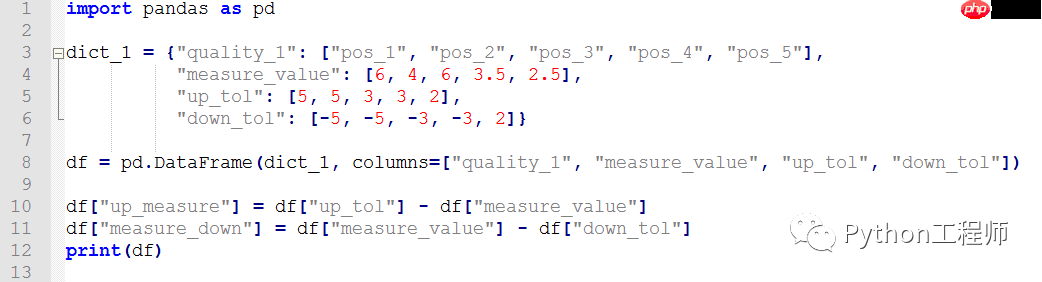
import pandas as pddict_1 = { "quality_1": ["pos_1", "pos_2", "pos_3", "pos_4", "pos_5"], "measure_value": [6, 4, 6, 3.5, 2.5], "up_tol": [5, 5, 3, 3, 2], "down_tol": [-5, -5, -3, -3, 2] }
df = pd.DataFrame(dict_1, columns=["quality_1", "measure_value", "up_tol", "down_tol"]) df["up_measure"] = df["up_tol"] - df["measure_value"] df["measure_down"] = df["measure_value"] - df["down_tol"] print(df)
代码截图:
Part 3:部分代码解读
df["up_measure"] = df["up_tol"] - df["measure_value"]
DataFrame
up_measure
以上就是Python-科学计算-pandas-02-两列相减的详细内容,更多请关注php中文网其它相关文章!

每个人都需要一台速度更快、更稳定的 PC。随着时间的推移,垃圾文件、旧注册表数据和不必要的后台进程会占用资源并降低性能。幸运的是,许多工具可以让 Windows 保持平稳运行。

 广告
广告Copyright 2014-2025 https://www.php.cn/ All Rights Reserved | php.cn | 湘ICP备2023035733号





 625
625








 收藏
收藏